
Run more AI workloads on every GPU you already own
Cast AI shares and partitions GPUs across workloads through time-slicing, MIG, and MPS, then automatically bin-packs placement so idle capacity gets used, with no changes to your workload manifests.
Trusted by 2100+ companies globally



Problem
The problem with whole-GPU allocation

Kubernetes hands out whole GPUs by default
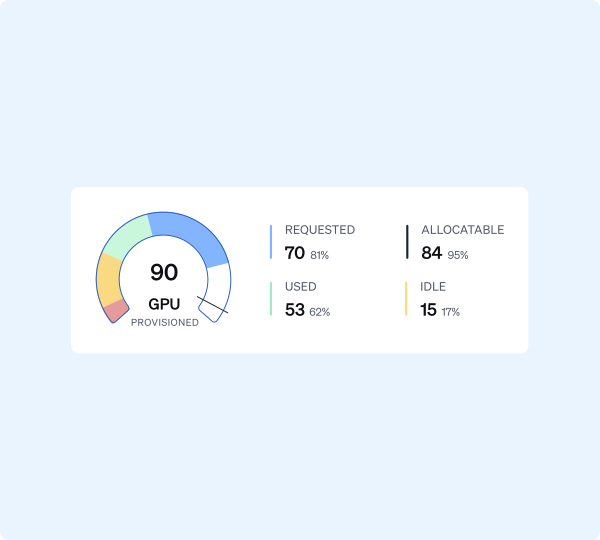
One pod claims an entire GPU no matter how much of it actually gets used, and most capacity sits idle.

Sharing methods aren’t one-size-fits-all
Time-slicing, MIG, and MPS trade off isolation, hardware, and cloud support differently. Pick wrong, and you either waste capacity or let workloads collide.

Manual configuration goes stale
Node templates set once for GPU sharing drift as workloads and clusters evolve, and nobody revisits them until something breaks.
Key features
More workloads per GPU, placed automatically
Share and partition GPUs your way
Time-slicing (1 to 48 replicas, any NVIDIA GPU), MIG (hardware-isolated partitions on A100, A30, H100, H200, and Blackwell-generation GPUs), or MPS (concurrent execution, live today on GCP GKE).
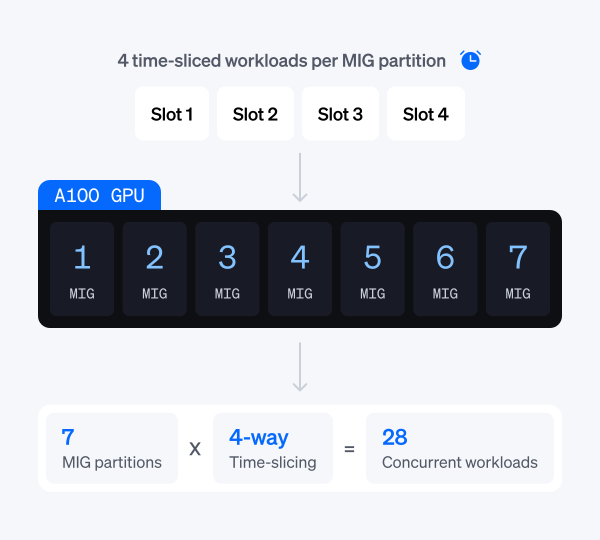
Combine them for maximum density: seven MIG partitions with 4-way time-slicing support 28 concurrent workloads on a single A100.
Automatic bin-packing across shared capacity
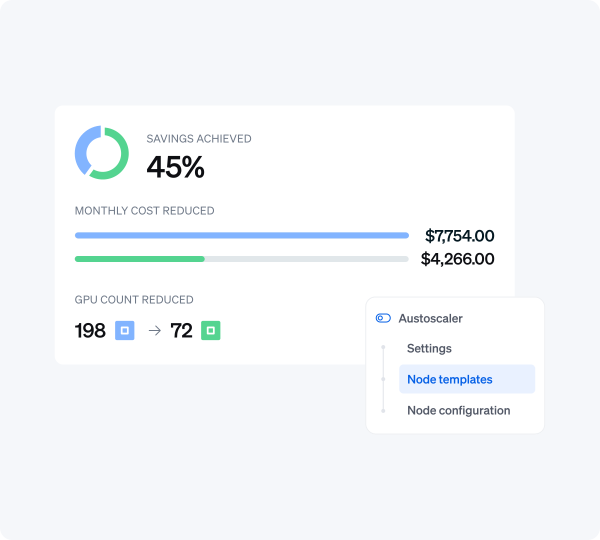
Cast AI’s placement engine bin-packs workloads across shared and partitioned GPUs automatically, maximizing utilization before scaling out new nodes. No scheduling logic to write into your manifests.
Visibility today, automatic recommendations on the way
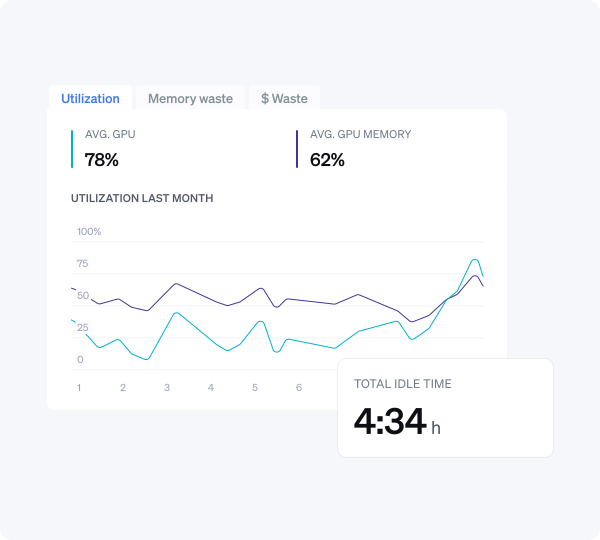
Real-time GPU utilization per workload is live today. Automatic, workload-aware sharing recommendations are on the roadmap.
Time-slicing
Share GPUs across multiple workloads using temporal partitioning. Configure 1 to 48 replicas per GPU to match workload density requirements.
MIG partitioning
Divide A100, A30, and H100 GPUs into physically isolated instances. Each partition has dedicated compute cores and memory with no noisy neighbors.
Dynamic resource allocation
Define what you need with Kubernetes-native ResourceClaims, and Cast AI provisions matching hardware automatically.
Global GPU capacity
Source GPU nodes from any region or cloud provider. OMNI handles provisioning and setup, so remote GPUs appear as native cluster nodes.
GPU-optimized bin-packing
Placement algorithm that accounts for GPU sharing, MIG partitions, and workload requirements. Maximize node utilization before scaling out.
GPU metrics & cost attribution
Track GPU utilization per workload, attribute costs to teams or apps, and spot idle capacity with optimization recommendations.
Case study
Akamai achieves 40-70% cloud savings, boosts engineer productivity
“I had an aha moment – an iPhone moment – with Cast. Literally two minutes into the integration, we saw the cost analytics, and I had an insight into something I had never had before and had tried to get for a very long time.”

Dekel Shavit
Sr. Director of Engineering
Case study
Yotpo automates Spot Instances, cuts 40% in cloud costs and saves time
“And with Cast AI, we didn’t do anything. Like, we didn’t do the move before, we didn’t do the move after. So there was a lot of human resources and time saved here. That was a very good experience. And again, from a cost perspective, it was highly optimized.”

Achi Solomon
Director of DevOps
Case study
Bede Gaming automatically optimizes K8s workloads with no risk to performance
“In my mind, it’s one less thing to worry about, and therefore teams can be focused on other things of potentially higher value. So having [Cast AI] just run in the background with a good level of confidence that we’re running as efficiently as we can, balancing the service that we’re providing – that’s great.”

Dan Whiteley
Chief Technology Officer
Learn more
Additional resources

Report
2025 Kubernetes GPU Trends & Cost Report
Real data on GPU availability, pricing patterns, and performance insights across clouds.

Blog
GPU Cost Optimization: How to Reduce Costs with GPU Sharing and Automation
GPU costs are skyrocketing as more teams run AI and ML workloads. Discover how GPU…

Blog
GPU Shortage Mitigation: How to Harness the Cloud Automation Advantage
Training AI models has never been buzzier – and more challenging due to the current…
FAQ
Your questions, answered
Time-slicing switches workloads on and off a GPU over time and runs on any NVIDIA GPU. MIG physically partitions a GPU into isolated instances with dedicated memory and compute. MPS runs multiple processes concurrently on a GPU instead of switching between them.
A100, A30, H100, H200, and Blackwell-generation GPUs (B200, GB200, RTX PRO 6000).
Not yet. MPS is live today on GCP GKE.
Yes. Seven MIG partitions with 4-way time-slicing on each support 28 concurrent workloads on a single A100.
Through the API today. A dedicated UI is shipping shortly.
Not yet. Real-time utilization per workload is visible today, and automatic sharing recommendations are on the roadmap.
No. Sharing is configured through node templates, and workloads request resources as usual.
Can’t find what you’re looking for?

4.8/5 50+ reviews