
Connect
the GPUs you already have
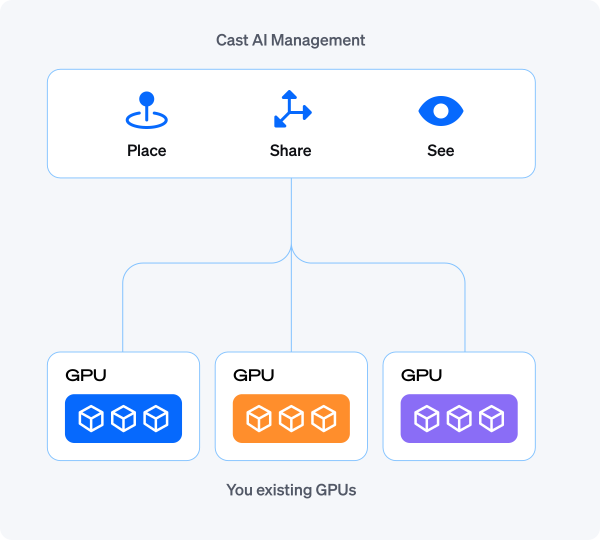
Bring your own reserved instances, private cloud nodes, or existing contracts, and let Cast AI manage placement, sharing, and visibility across all of it. No new cluster. No change in who you buy GPUs from.

Trusted by 2100+ companies globally


Problem
The problem with fragmented GPU capacity

Your GPU capacity is already spread across accounts and contracts
Reserved instances in one account, private cloud nodes in another, maybe hardware you already own. None of it behaves like one fleet today.

Switching providers isn’t always the answer
Sometimes the constraint isn’t finding new GPUs. It’s making the GPUs you already committed to work as one coordinated system.

A second cluster per environment doesn’t scale
Standing up a separate cluster for every account or location multiplies operational overhead instead of reducing it.
Key features
Your GPUs, one coordinated system
One cluster, your existing GPU capacity
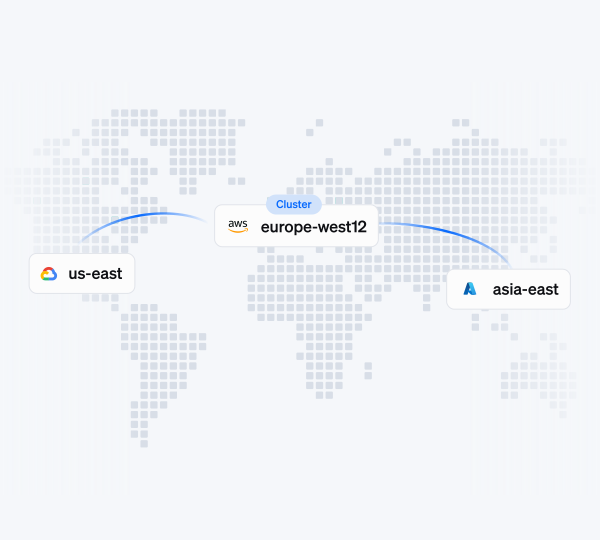
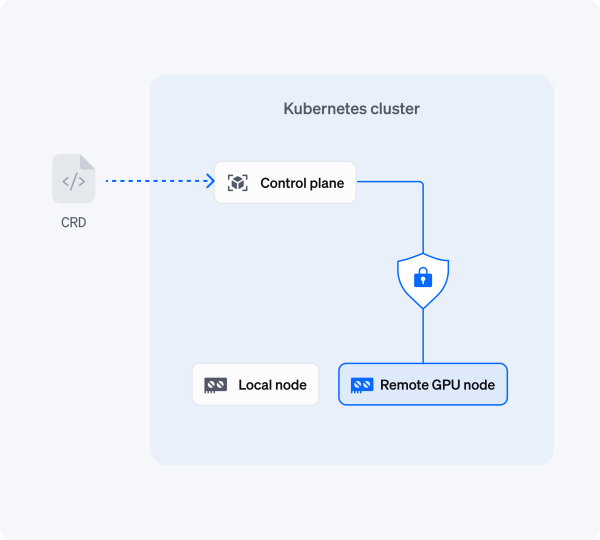
Connect reserved capacity in other accounts, private cloud nodes, or your own infrastructure to your existing Kubernetes cluster. Cast AI manages placement and sharing. You keep your existing contracts and providers.
Kubernetes-native connectivity, no second cluster
The same Crossplane and CRD-based provisioning that connects OMNI-sourced GPU capacity works whether Cast AI sourced the GPUs or you already own them. Nodes join as native cluster members over a secure WireGuard connection.
Management only, when you don’t need sourcing
Already have the GPU capacity you need? Use Cast AI purely for placement, sharing, and visibility across it, without paying for or routing through Cast AI’s GPU sourcing.
Time-slicing
Share GPUs across multiple workloads using temporal partitioning. Configure 1 to 48 replicas per GPU to match workload density requirements.
MIG partitioning
Divide A100, A30, and H100 GPUs into physically isolated instances. Each partition has dedicated compute cores and memory with no noisy neighbors.
Dynamic resource allocation
Define what you need with Kubernetes-native ResourceClaims, and Cast AI provisions matching hardware automatically.
Global GPU capacity
Source GPU nodes from any region or cloud provider. OMNI handles provisioning and setup, so remote GPUs appear as native cluster nodes.
GPU-optimized bin-packing
Placement algorithm that accounts for GPU sharing, MIG partitions, and workload requirements. Maximize node utilization before scaling out.
GPU metrics & cost attribution
Track GPU utilization per workload, attribute costs to teams or apps, and spot idle capacity with optimization recommendations.
Setup
Get started in four steps

Select your provider and run a single script to deploy lightweight agents that will analyze and optimize your cluster.

Choose the best regions based on availability, latency, and costs. Add it to your existing cluster.

Set your node templates and let Cast AI optimize your cluster automatically.

Deploy AI Workloads anywhere and keep your cluster optimized.
Case study
Akamai achieves 40-70% cloud savings, boosts engineer productivity
“I had an aha moment – an iPhone moment – with Cast. Literally two minutes into the integration, we saw the cost analytics, and I had an insight into something I had never had before and had tried to get for a very long time.”

Dekel Shavit
Sr. Director of Engineering
Case study
Yotpo automates Spot Instances, cuts 40% in cloud costs and saves time
“And with Cast AI, we didn’t do anything. Like, we didn’t do the move before, we didn’t do the move after. So there was a lot of human resources and time saved here. That was a very good experience. And again, from a cost perspective, it was highly optimized.”

Achi Solomon
Director of DevOps
Case study
Bede Gaming automatically optimizes K8s workloads with no risk to performance
“In my mind, it’s one less thing to worry about, and therefore teams can be focused on other things of potentially higher value. So having [Cast AI] just run in the background with a good level of confidence that we’re running as efficiently as we can, balancing the service that we’re providing – that’s great.”

Dan Whiteley
Chief Technology Officer
Learn more
Additional resources

Report
2025 Kubernetes GPU Trends & Cost Report
Real data on GPU availability, pricing patterns, and performance insights across clouds.

Blog
GPU Cost Optimization: How to Reduce Costs with GPU Sharing and Automation
GPU costs are skyrocketing as more teams run AI and ML workloads. Discover how GPU…

Blog
GPU Shortage Mitigation: How to Harness the Cloud Automation Advantage
Training AI models has never been buzzier – and more challenging due to the current…
FAQ
Your questions, answered
Reserved instances in other accounts, private cloud nodes, or GPU capacity you’ve already contracted directly.
No. It connects to your existing cluster as native nodes.
Yes. If you already have the GPU capacity you need, Cast AI handles placement, sharing, and visibility without routing through Cast AI’s sourcing.
This is still being confirmed. Talk to us about your specific setup before assuming support.
The same Crossplane and CRD-based provisioning used for OMNI-sourced capacity, over a secure WireGuard connection.
Yes. Your own capacity and OMNI-sourced capacity can operate as one system.
Can’t find what you’re looking for?

4.8/5 50+ reviews